
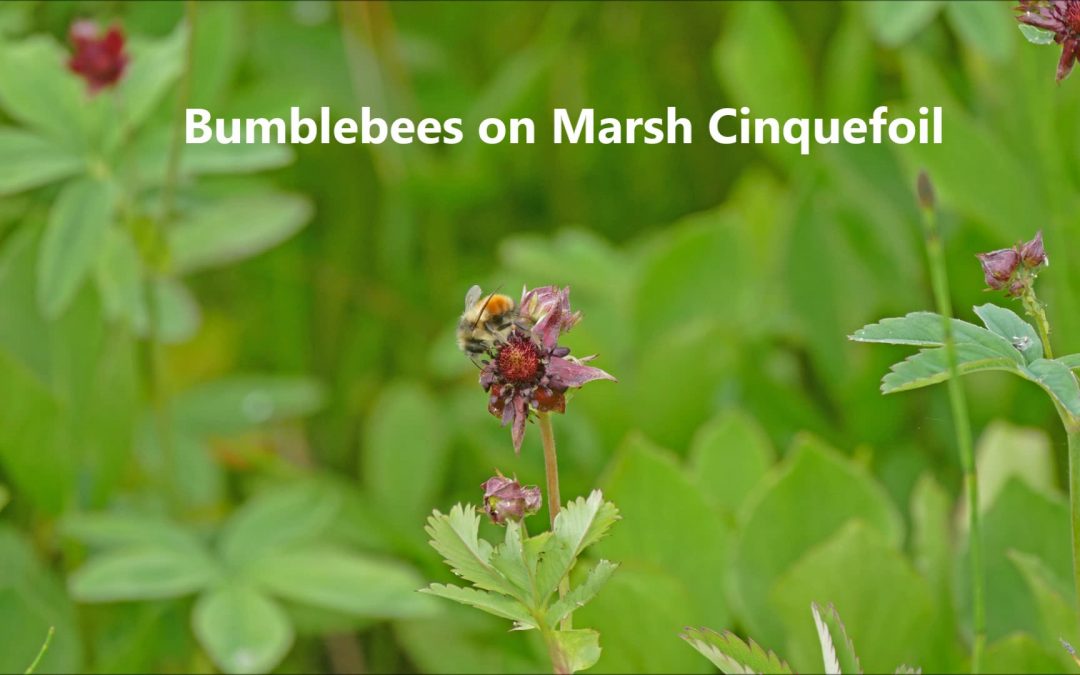
- Bumblebees on Marsh Cinquefoil is a video of them at the Very Beary Berry Wetlands in Juneau, Alaska.
Marsh cinquefoil likes wet, boggy places, fens and peaty meadows. When it is in flower, between May and July, it is a good source of food for nectar-loving insects, such as bees and hoverflies.
One particular type of weevil, Phytobius comari, lives on nothing but Marsh cinquefoil.
The flowers emit a fetid odor and also secrete nectar that attracts carrion flies as well as other kinds of flies and bees.
From NatureGate:
Marsh cinquefoil likes to grow in different kinds of wetlands, where cranes are known to thrive. The plant often stretches a shoot out from the shore onto the water and starts to grow in a new area. Semi-buoyant root discs spread and catch the mud and sediment from the shore. The root disc can bear a weight equivalent to a human being on its surface which is extremely soft and stinks of bog gas. Bog moss gradually joins the root disc, muddy swamp margins start to predominate over an increasing area, and gradually the surface of the pond closes over. Marsh cinquefoil that starts to grow on the edge of open water thrives in saturated waterside meadows that are prone to flooding and can survive in an alder grove on the site of the original pond.
Due to its characteristic appearance marsh cinquefoil is easy to recognize, at least when it is in flower, and it is well known to Finns in general. It is one of those plants that has been deemed necessary to place in its own genus: it was formerly a member of genus Potentilla but is now in genus Comarum. After flowering its flower-stalks become slightly shiny swelling float for the achenes. Even clearer identification markers are its dark red flowers, while those of genus Potentilla are yellow. Marsh cinquefoil’s browny red sepals can easily be mistaken for petals – the real petals are much smaller, narrower, and blackish red.
Bumblebees on Marsh Cinquefoil
https://vimeo.com/574070308