
- This video shows a few of the birds in Alaska that dive underwater for their food. It is fun to learn how deep they can actually dive. However most of their dives are much shorter.
- The Common Goldeneye forages mostly in shallow water along shorelines (usually < 4 m deep). May feed occasionally in deeper water (6–7 m). Dives easily without an exaggerated leap or plunge. Plumage becomes compressed before diving. Holds wings close to body underwater, using only feet for propulsion. Eadie, J. M., M. L. Mallory and H. G. Lumsden. 1995. Common Goldeneye (Bucephala clangula), The Birds of North America Online (A. Poole, Ed.). Ithaca: Cornell Lab of Ornithology; Retrieved from the Birds of North America Online: http://bna.birds.cornell.edu/bna/species/170
- The Marbled Murrelet dives underwater to forage by using wings to propel itself. Known to dive to depths of at least 50 m. Nelson, S. Kim. 1997. Marbled Murrelet (Brachyramphus marmoratus), The Birds of North America Online (A. Poole, Ed.). Ithaca: Cornell Lab of Ornithology; Retrieved from the Birds of North America Online: http://bna.birds.cornell.edu/bna/species/276
- The Pigeon Guillemot dives and maneuvers underwater using partially opened wings mainly; underwater wingbeat rate 2.1/s. Feet used as rudders underwater but, unlike other alcids, for propulsion too. Ewins, Peter J. 1993. Pigeon Guillemot (Cepphus columba), The Birds of North America Online (A. Poole, Ed.). Ithaca: Cornell Lab of Ornithology; Retrieved from the Birds of North America Online: http://bna.birds.cornell.edu/bna/species/049
- The Pacific Loon in shallow water, forages from surface and captures invertebrates by head-dipping; in deeper water, dives for fishes (when present). Individuals foraging from the surface may occasionally attempt to expose benthic organisms by disturbing bottom sediments with the bill. Diving behavior differs slightly from that of Common Loon: Pacific and Arctic loons stretch their necks up and erect to full length before going underwater, usually jumping upward slightly before diving, whereas Common Loons simply “slither” under slowly while diving forward. Russell, Robert W. 2002. Pacific Loon (Gavia pacifica), The Birds of North America Online (A. Poole, Ed.). Ithaca: Cornell Lab of Ornithology; Retrieved from the Birds of North America Online: http://bna.birds.cornell.edu/bna/species/657a
- The Long-tailed Duck is a strong and deep diver. Diving preceded by a small jump. Partially extends wings and spreads tail before diving; maintains head and neck outstretched while diving . Flaps partially folded wings for propulsion; apparently does not use feet for propulsion, unlike other sea ducks . Ascent is quick and actively swims to surface, again unlike other sea ducks, which return passively to the surface. Robertson, Gregory J. and Jean-Pierre L. Savard. 2002. Long-tailed Duck (Clangula hyemalis), The Birds of North America Online (A. Poole, Ed.). Ithaca: Cornell Lab of Ornithology; Retrieved from the Birds of North America Online: http://bna.birds.cornell.edu/bna/species/651
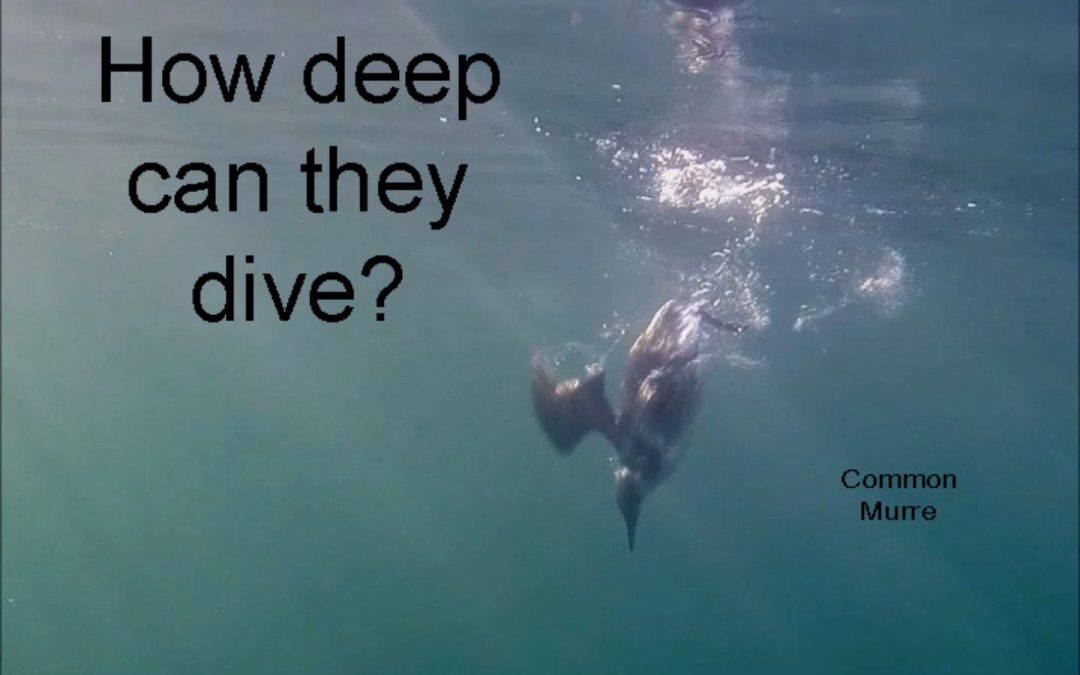
- The Common Murre is among the largest of the living Alcidae and a consummate diver, the Common Murre reaches depths of more than 100 meters in search of prey, mainly fish but also invertebrate s (euphausiids, cephalopods). It often forages in flocks, including multispecies assemblages. Its smallish wings, a compromise for underwater wing-propelled diving and aerial flight, require rapid beats to remain aloft. This high wing-loading, plus diving in cool waters and possessing poor insulation, contributes to an energetically costly life style. Dives deep for a relatively small bird (cf. loons, penguins), often to 70 m and occasionally to 180 m. Ainley, David G., David N. Nettleship, Harry R. Carter and Anne E. Storey. 2002. Common Murre (Uria aalge), The Birds of North America Online (A. Poole, Ed.). Ithaca: Cornell Lab of Ornithology; Retrieved from the Birds of North America Online: http://bna.birds.cornell.edu/bna/species/666
- Piatt, J.F. and D.N. Nettleship. 1985. diving depths of four alcids. Auk 102:293-97.
- Schorger, A.W. 1947. The deep diving of the loon and old-squaw and its mechanism. Wilson Bull. 59: 151-59.
- Also look at this article by Mary Willson Diving into birds underwater
How deep can they dive
https://vimeo.com/158278409