
- Looking for the Arctic Bristletail is a project I just started on and hope to improve in the future.
- The Arctic Bristletail (Petridiobius arcticus) is an amazing insect that lives in the upper intertidal zone in Southeast Alaska.
- It is a species of jumping bristletail in the family Machilidae. It is found in Europe & Northern Asia (excluding China) and North America.
- It has no wings but is capable of jumping up to 20 cm.
- I first discovered their presence in Juneau by seeing lots of their exoskeletons on a large rock along a shore in Juneau. It was fascinating how clustered together they were during the molting stage.
- Bristletails are small invertebrates that slightly resemble tiny lobsters. Petridiobius arcticus, is found from the Aleutian Islands to the Alaska panhandle where they live in cracks of bedrock just above the high tide line and feed on lichens.
- The following is from Matt Bowser, Fish and Wildlife Biologist on the Life history of Petridiobius arcticus:
First instar immatures hatch from eggs in early spring, April to May in Southcentral Alaska. These grow over the summer, molting a couple of times or so (I do not know exactly) so that they are nearly mature in the fall. They overwinter in cracks of rocks or under moss and reach maturity by the end of their second summer, when eggs are laid in the moss and other material among the rocks.
They are easy to raise from first instar to adulthood by feeding them lichens and providing water. They will lay eggs in captivity, but I have not been able to provide the correct conditions for eggs to hatch. I think these need to go through one winter before they will hatch.
In captivity the P. arcticus will eat almost any kind of lichen.
Behavior:
Petridiobius arcticus will be out in daylight. In particular, some will be out apparently sunning on warm days. They are mostly crepuscular/nocturnal, however. If you wait around at night with a deep red light to watch them you will see many bristetails emerging from the rocks.
There is much more to learn, though. No one has documented the mating behavior of this species, for example. We also have very little information on interactions with other species. I do not think that there is documentation of any predation on P. arcticus.
- To learn more about them look at http://archaeognatha.myspecies.info/taxonomy/term/148/descriptions
- Some interesting information about them can be found in the book Insects Their Natural History and Diversity by Stephen A. Marshall. The following information is taken from his book:
- These primitive, robust insects are easiest to observe along rocky seashores. Jumping Bristletails are such striking insects it is worth turning over a few rocks to see them.
- They feed on algae and lichens.
- The males do not mate directly with the females.
- Jumping bristletails .......sometimes use a silken line as a carrier thread on which the male deposits his sperm droplets before nudging the female into position to contact his sperm with the lip of her abdomen.
- In order to cast a skin to enable growth they use their own feces to anchor themselves down to solid surface, such as a rock.
- They also glue their eggs to rocks.
- Mandibles of jumping bristletails swing on a single pivot, much like a leg.
Looking for the Arctic Bristletail
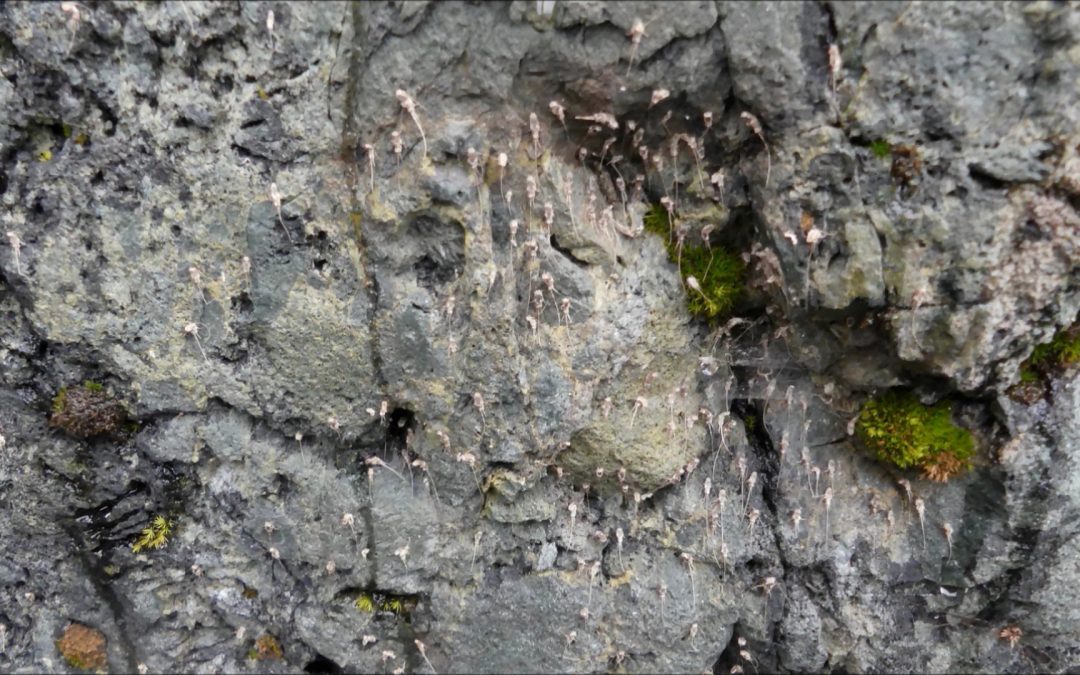
https://vimeo.com/462158637