
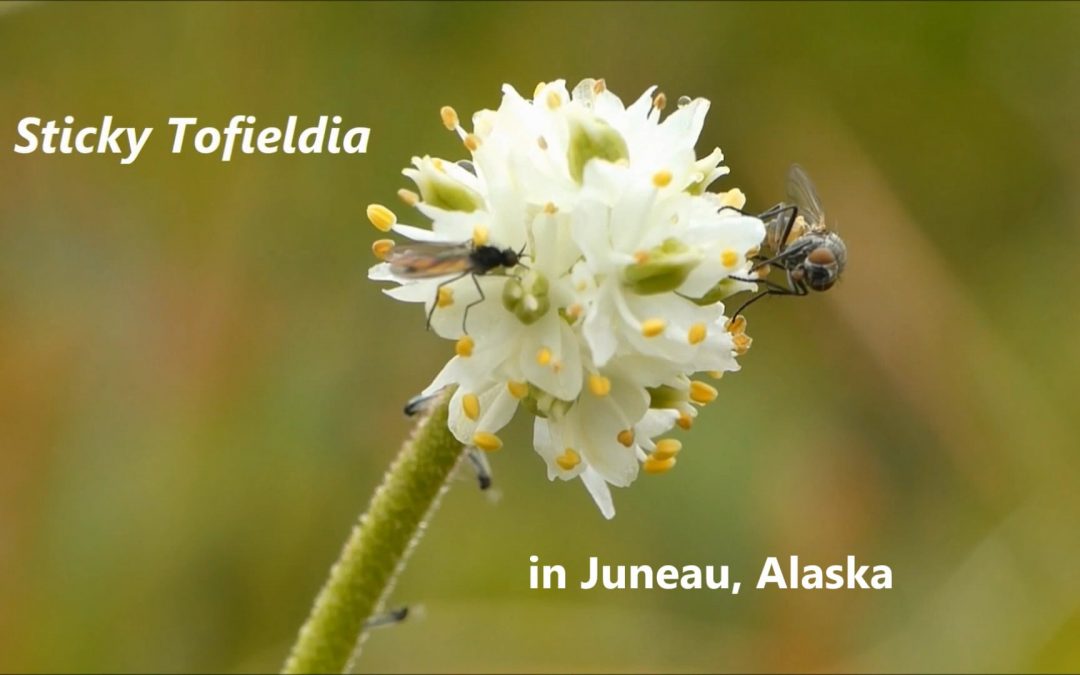
- Sticky Tofieldia in Juneau, Alaska shows a plant that captures insects on its stem.
- To learn more about a close relative of this plant look at /sites/default/files/e2022724118.full.pdf
- And this sketch by Kathy Hocker /sites/default/files/KH-tofieldia.pdf
- It looks like the larger insect it has captured is a Black Fly. From Bugnet Guide: Adult: black to various shades of gray or yellow; thorax shiny, strongly convex, giving a humpbacked, gnat-like appearance; wings clear, broad, without hairs or scales; heavy veins near anterior wing margin, weak veins posteriorly; small head with large round eyes and short 11-segmented antennae; ocelli lacking
- Also from Bugnet Guide: Black flies attack most severely about sunrise and at sunset -- either massively and viciously or in such small numbers that they are scarcely noticeable. They bite painlessly so that you may not be aware of having been attacked until small droplets of blood start oozing from your skin. Black flies often crawl into your hairline or through openings in your clothes before they bite you. Therefore, the bites are usually behind your ears, around your neck and beltline, and on the lower parts of your legs. A typical bite consists of a round, pink, itchy swollen area, with a droplet of fresh or dried blood at the center. When the blood is rubbed away, a minute subcutaneous hemorrhage is visible. This hemorrhage and the surrounding pink area become diffuse and larger, and then disappear within a few days. Itching may continue intermittently for weeks, whenever the bitten area is rubbed. Scratching may cause severe secondary skin infections. Toxins injected during an extended severe attack can cause a general illness sometimes called black-fly fever, characterized by headache, fever, nausea, and swollen, painful neck glands. Attacks occur throughout late spring and early summer (sometimes throughout the summer). (Fredeen 1973)(5
- To learn more about this plant look at this article by Mary Willson
- https://www.juneauempire.com/news/on-the-trails-a-not-at-all-mythical-st...
Sticky Tofieldia in Juneau, Alaska
https://vimeo.com/585187758