
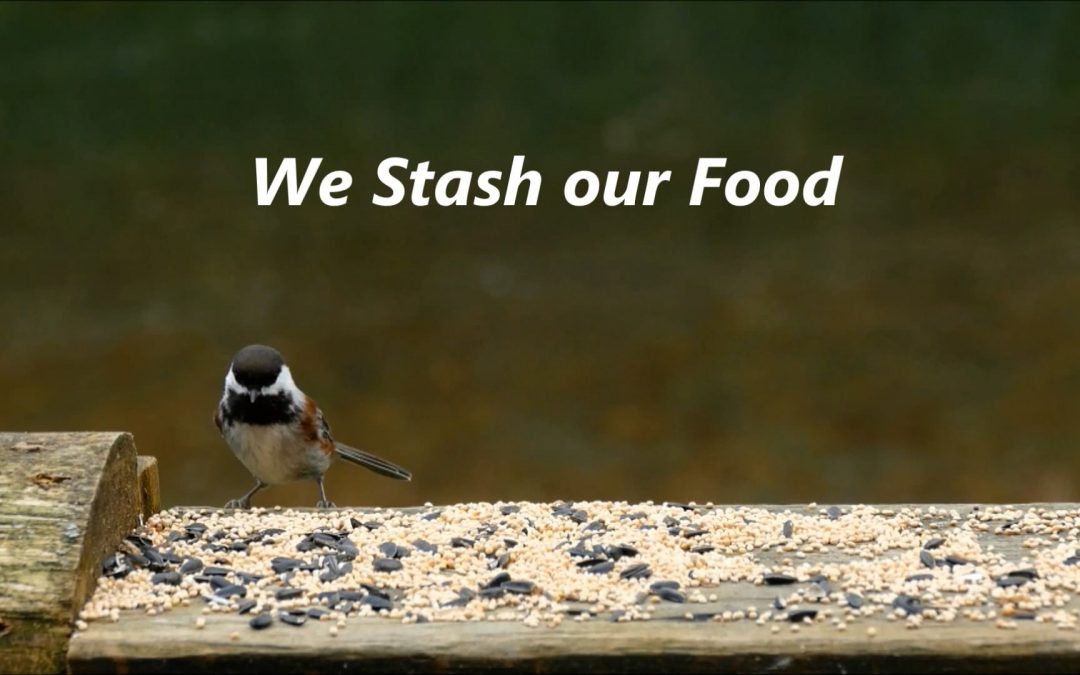
- We Stash Our Food shows Chestnut-backed Chickadees and Red-breasted Nuthatches taking sunflower seeds from a feeder and flying off to store them.
- Most of the birds were going to a Western Hemlock Tree which has lots of cracks in the bark and places for them to store food.
- For Chestnut-backed Chickadees:
From: Dahlsten, D. L., L. A. Brennan, D. A. McCallum, and S. L. Gaunt (2020). Chestnut-backed Chickadee (Poecile rufescens), version 1.0. In Birds of the World (A. F. Poole and F. B. Gill, Editors). Cornell Lab of Ornithology, Ithaca, NY, USA. https://doi.org/10.2173/bow.chbchi.01
No observations of Chestnut-backed Chickadees caching and hoarding food in wild.
However, potential for food-caching and hoarding by this species in wild clearly exists. Varley (Varley 1974) observed that captive Chestnut-backed Chickadees from Vancouver, British Columbia, area readily cached and hoarded food. At Blodgett Forest Research Station, El Dorado Co., CA, lack of caching and hoarding behavior by this chickadee during winter attributed to presence of an abundant scale insect (Xylococculus macrocarpae) that lives on incense cedar (Morrison et al. 1989a, Tait et al. 1990).
Ecological and evolutionary implications of food storing in relation to factors such as body size and social organization are poorly understood (Sherry 1989). Further examination of this issue with wild Chestnut-backed Chickadees may resolve this issue for this species and contribute to the larger understanding of this behavior in parids and other birds.
For Red-breasted Nuthatches:
From Ghalambor, C. K. and T. E. Martin (2020). Red-breasted Nuthatch (Sitta canadensis), version 1.0. In Birds of the World (A. F. Poole and F. B. Gill, Editors). Cornell Lab of Ornithology, Ithaca, NY, USA. https://doi.org/10.2173/bow.rebnut.01
“Like other nuthatches, regularly stores food during fall and winter. Where resident, caching of food is probably critical to overwinter survival. Caches both seeds and arthropods, although stores primarily conifer seeds. Places cached food in crevices under bark, in holes created by sapsuckers (Sphyrapicus spp.), or occasionally in the ground (Tyler 1948b, Kilham 1974c, Hendricks 1995). Often, but not always, covers caches with small fragments of bark, lichen, or small rocks, presumably to conceal food from competitors (Kilham 1974c, Hendricks 1995). Hendricks (Hendricks 1995) reported only 44% of (n = 17) caches covered, and in all cases materials used to cover caches were obtained without the bird having to move to new position (see also Kilham 1974c).”
We Stash Our Food
https://vimeo.com/609501856